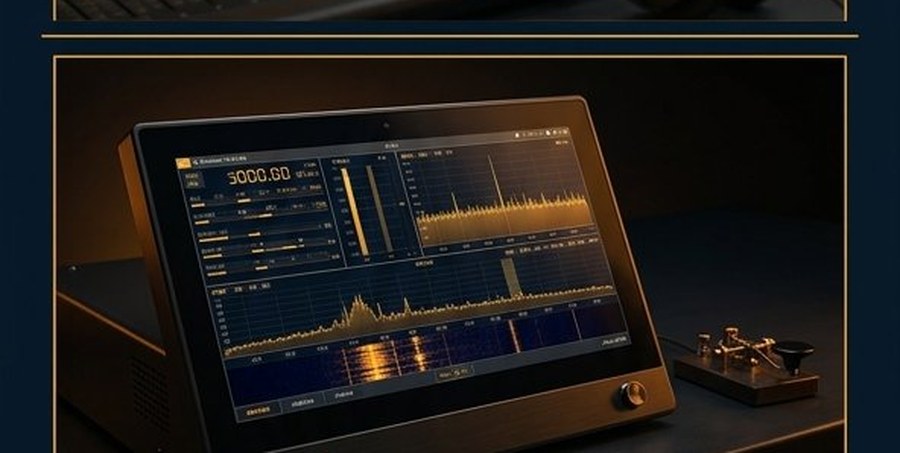
An RTL-SDR dongle is a small USB stick — originally designed as a cheap DVB-T television receiver — that was discovered by the radio hobbyist community to work as a broadband software-defined radio receiver covering roughly 25 MHz to 1.75 GHz. For around $25, you get a receive-only radio that can listen to aircraft transponders, decode weather satellite imagery, monitor VHF/UHF amateur bands, receive weather radio, and much more. It is probably the best entry point in all of hobby radio.
No license required to receive. In the U.S., listening to most radio transmissions is legal for anyone. An RTL-SDR is a receive-only device — no transmitting means no FCC license needed to get started. It's an excellent way for prospective ham radio operators to explore the hobby before passing an exam.
What to Buy
The RTL-SDR Blog V4 is the current recommended hardware at ~$30 from rtl-sdr.com. It includes an improved R820T2 tuner chip, a TCXO oscillator for better frequency accuracy, and a small whip antenna set adequate for initial experiments. Avoid the generic Amazon dongles — they use inferior chipsets that affect receive performance and often have driver issues.
For better HF receive performance (below 25 MHz — shortwave, AM broadcast, ham HF bands), add an RTL-SDR Blog HF upconverter or step up to the Airspy HF+ Discovery (~$170), which covers HF and VHF with excellent sensitivity and selectivity.
Software to Install
- SDR# (SDRSharp) — Windows only, most polished interface, best plugin ecosystem. Download at airspy.com/download. Handles FM, AM, SSB, and more with a clean waterfall display.
- GQRX — Linux and Mac, open-source, nearly as capable as SDR#. The go-to for non-Windows users.
- SDR++ — Cross-platform, modern interface, actively developed. Growing rapidly in popularity.
- Zadig (Windows driver tool) — Required on Windows before using any SDR# — it replaces the default USB driver with WinUSB. Run Zadig first before plugging in your dongle.
What You Can Do with an RTL-SDR
Aircraft Tracking (ADS-B) with dump1090 / VirtualRadar
Tune to 1090 MHz and decode ADS-B transponder signals from commercial aircraft — callsign, altitude, speed, heading, and position. VirtualRadarServer displays them on a moving map in your browser. You can even feed your data to Flightradar24 or FlightAware and they'll give you a free premium account.
Weather Satellite Imagery (NOAA APT)
NOAA-15, -18, and -19 broadcast live weather imagery at 137 MHz continuously as they orbit overhead. Using a V-dipole antenna pointed straight up, WXtoImg or Satdump software, and your RTL-SDR, you can decode actual satellite cloud imagery as the satellite passes overhead — in about 10 minutes of overhead time, twice a day. The images are genuinely beautiful and the process is incredibly satisfying.
VHF/UHF Amateur Band Monitoring
Listen to 2m and 70cm FM repeaters, local simplex activity, APRS packets at 144.390 MHz, and amateur satellites passing overhead. The RTL-SDR covers all of it without a license. Many new hams use an RTL-SDR to "listen first" on local repeaters before making their initial transmissions.
NOAA Weather Radio
All seven NOAA Weather Radio frequencies (162.400–162.550 MHz) come in clearly on an RTL-SDR. Monitor NWS alerts, watch for SAME emergency tone alerts, and log broadcast weather data. A useful backup to commercial weather radio receivers.
P25, DMR, and Digital Voice
Using DSD+ or SDR Trunk software, you can decode digital voice transmissions on P25 (used by many public safety agencies), DMR, and NXDN systems in your area. Depending on whether the systems are encrypted (many are), you can monitor local police, fire, and EMS communications. Check your local laws — monitoring is legal in most U.S. states but varies by jurisdiction.
Antennas: The RTL-SDR's Biggest Limitation
The small whip antenna that ships with the RTL-SDR Blog kit works for initial experiments, but it's mediocre for anything requiring range or sensitivity. Upgrading your antenna makes a dramatic difference:
- ADS-B (1090 MHz) — A 1090 MHz colinear or FA 1090 MHz antenna improves aircraft range from 50–100 miles to 200+ miles.
- NOAA weather satellites (137 MHz) — A crossed dipole (turnstile) or V-dipole aimed at zenith dramatically improves satellite imagery quality.
- VHF/UHF general use — A discone antenna (~$40) covers 25 MHz–1.3 GHz omnidirectionally and is the best all-around RTL-SDR upgrade.
- HF bands — A long wire antenna (30–100 feet) connected through an upconverter opens shortwave, AM broadcast, and the ham HF bands.
Limitations to Know
- Receive only — the RTL-SDR cannot transmit. You need a proper transceiver for that.
- Modest dynamic range — strong local signals can overload the receiver. An FM broadcast band filter helps in urban areas near broadcast towers.
- Coverage starts around 25 MHz without an upconverter — you'll miss AM broadcast and shortwave below that.
- Frequency stability is decent on the V4 model with TCXO but not laboratory-grade.
Best next step: If the RTL-SDR sparks your interest in amateur radio, your logical next move is studying for a Technician license. The skills you develop monitoring VHF/UHF with an SDR translate directly to operating on those same bands with your own transmitter. See our licensing guide to get started.
Choosing Your First RTL-SDR Dongle
Not all RTL-SDR dongles are equal. The original RTL-SDR Blog V3 and the newer V4 (released 2023) are the gold standard for ham radio use — they include a bias tee for powering external LNAs, a 1 PPM TCXO for frequency stability, a proper SMA connector instead of the flimsy MCX, and a metal enclosure that reduces heat-related drift. At ~$35–40 direct from rtl-sdr.com, they're worth the extra $15 over a generic Realtek dongle from Amazon.
For 2m/70cm monitoring and ADS-B aircraft tracking, either version works well. If you want to receive GPS signals, go active GPS antenna signals, or work below 500 kHz with an upconverter, the V4 adds direct sampling mode that extends receive range significantly downward. For most new operators monitoring VHF/UHF repeaters, weather satellites, and aircraft transponders, the V3 remains entirely adequate.
Software Options Beyond SDR#
SDR# (SDRSharp) is the most popular Windows option and the easiest starting point. But it's not the only choice:
- GQRX — The go-to for Linux and macOS. Open-source, actively maintained, excellent for general scanning and demodulation. More stable than SDR# on some systems.
- CubicSDR — Cross-platform, clean interface, good for beginners who want something that works on any OS without configuration headaches.
- SDR++ — A newer, faster alternative to SDR# that's gaining popularity. Better performance on lower-end hardware and excellent plugin support.
- OpenWebRX — Runs a web-based SDR receiver you can share with others on your local network or the internet. Popular for club stations and public SDR nodes.
What to Actually Listen To: A Starter Guide
The RTL-SDR covers roughly 500 kHz to 1.7 GHz depending on the software and configuration. Here's what's worth tuning to as a new operator:
- Local VHF/UHF repeaters (144–148, 420–450 MHz): Your local ham repeaters. Program your local repeater frequencies from RepeaterBook and monitor them. Compare signal strength to your handheld — the RTL-SDR often surprises you with what it can hear from a good antenna position.
- ADS-B aircraft transponders (1090 MHz): Install dump1090 or the Flightradar24 feeder app. Point the antenna out a window and you'll see every commercial aircraft within ~150 miles as a live map on your screen within minutes. One of the most immediately impressive RTL-SDR demonstrations.
- NOAA weather satellites (137.500, 137.620, 137.9125 MHz): With a simple V-dipole or turnstile antenna, you can receive live weather satellite imagery directly from NOAA APT satellites. The images download as the satellite passes overhead, visible in software like WXtoImg or Satdump.
- ACARS aircraft data (131.550 MHz): Short digital messages between aircraft and ground stations. Decoded with ACARSDEC or PlanePlotter.
- Trunked P25 scanner systems: With trunk-recorder or SDRTrunk, you can follow your local public safety trunked radio system (where legal to monitor).
Antenna Makes Everything
The stubby whip antenna included with most RTL-SDR kits is barely adequate. For serious monitoring, even a simple home-built dipole cut to the frequency of interest dramatically outperforms it. For the bands most relevant to ham radio:
- 2m (146 MHz): A 19-inch vertical element with a ground plane. Build it from copper wire and an SO-239 chassis connector for under $5.
- 70cm (432 MHz): A 6.5-inch vertical element, same approach.
- ADS-B (1090 MHz): A collinear or commercial ADS-B antenna. The FlightAware 1090 antenna (~$45) is the most popular commercial option and performs measurably better than DIY at this frequency.
- Weather satellites (137 MHz): A turnstile or quadrifilar helix (QFH) antenna. The QFH is the best but takes a few hours to build — worth it for clean satellite imagery with no fading.
For general broadband monitoring, the RTL-SDR Blog wideband dipole kit (~$25) is a practical all-around solution that covers most of the spectrum the dongle can receive.
Connecting RTL-SDR to Ham Radio Software
One underused application: feeding your RTL-SDR into WSJT-X or other digital mode software as a panadapter or band monitor. With software like SDR-Console or HDSDR, you can pipe audio from the RTL-SDR into WSJT-X and monitor an entire FT8 passband simultaneously, seeing all signals at once before choosing which to decode. This doesn't replace a proper HF receiver but it's a useful visualization tool.
Spyserver lets you stream the RTL-SDR over your local network or the internet, allowing remote access from another computer or the SDR# network client. Handy for monitoring from a different room or remotely over VPN.
Recommended Tool
RTL-SDR Blog V3 SDR Receiver
A dedicated RTL-SDR running alongside your main station gives you a real-time spectrum and propagation monitor without tying up your transceiver. The RTL-SDR Blog V3 is the community-recommended unit — proper SMA connector, 1PPM TCXO for frequency stability, and a metal enclosure that cuts thermal drift. Under $40 delivered, it's one of the most useful additions to any ham shack.
As an Amazon Associate, Ham Radio Field Directory earns from qualifying purchases. This does not affect our editorial decisions.
Find on Amazon →